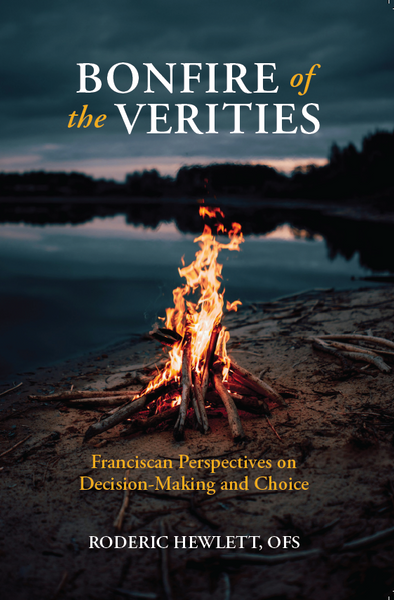
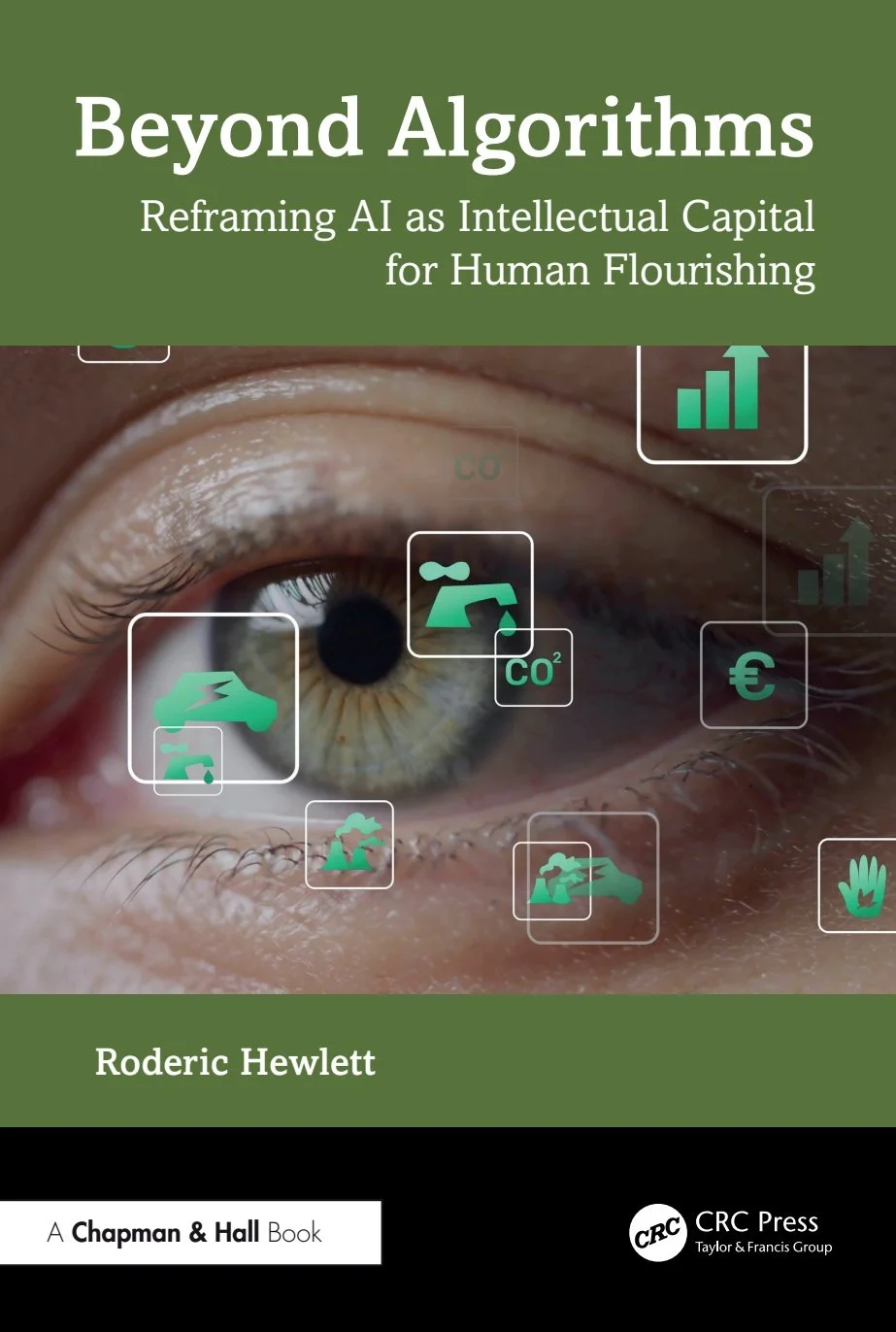
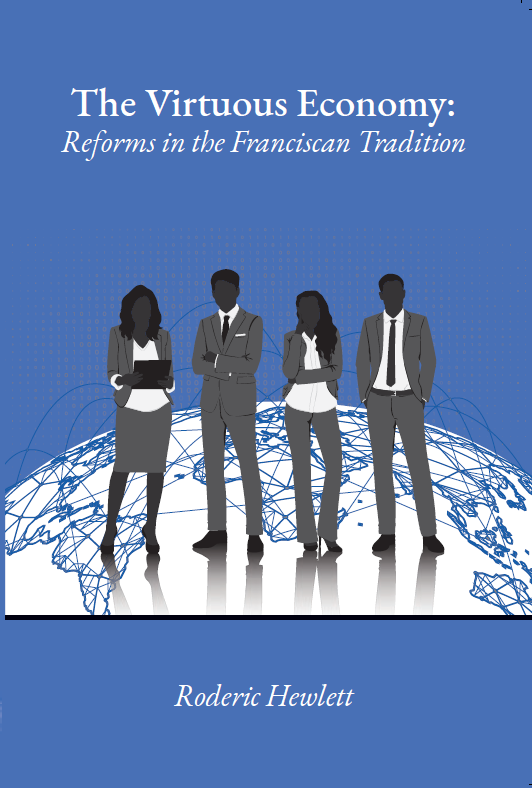
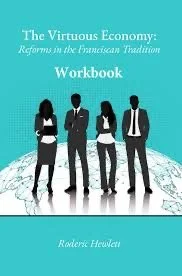
Roderic Hewlett is an economist and author whose work develops a unified theory of capital—human, intellectual, and ethical—to explain how institutions sustain alignment, trust, and performance across time in an increasingly AI-driven world. Rod’s work explores how institutional structures foster human flourishing. His writing examines how human formation, ethical capital, and stakeholder relationships shape economic systems, leadership, and emerging technologies. Drawing from the Franciscan intellectual tradition, Rod integrates virtue, sustainability, and moral responsibility into modern economic and organizational thought. He is the author of multiple books on ethics, capital theory, AI, and Franciscan perspectives on decision-making and institutional development.
Work In Process
Stakeholders Agency in the Age of AI: New Signals for a Post-Intervention Economic Era (CRC Press, forthcoming January 17, 2027) advances a stakeholder-augmented macroeconomic model that integrates ethical capital, AI as a market-mediating signal, stakeholder signaling, and long-horizon institutional accountability.
The Secular Franciscan Way of Life: Called, Commissioned, and Committed (Franciscan Institute Publications, in press, forthcoming 2027) offers a formation-centered vision of vocation, mission, and disciplined discipleship for Secular Franciscans in the modern Church.
Ordo Bonorum: A Thomistic Reconstruction of Economic Rationality (Manuscript in Peer Review). A reconstruction of economic rationality rooted in Thomistic anthropology, Catholic social teaching, and moral development. The project presents the Ordo Bonorum Utility Framework, uniting a hierarchy of goods, virtue cultivation, formation, and intertemporal economic choices into a cohesive model that connects theology, philosophy, and economic preferences and rationality.
AI and the Transformation of the Knowledge Economy: Why Hope Is Not a Plan (Book Proposal in External Peer Review — CRC Press). This project investigates how AI restructures the knowledge economy. The work analyzes how AI systems generate, validate, share, and convert knowledge into capital. It combines insights from institutional economics, intellectual capital theory, AI governance, and decision-making frameworks to show how AI accelerates processes, shifts competitive edges, and changes economic coordination across sectors.
Continue Exploring the Work
Scroll down to explore:
• Contributed book chapters and journal publications
• Workshops, keynote presentations, and conference papers
• Research on AI, stakeholder economics, leadership, and institutional trust
• Current research initiatives and future writing projects
• Franciscan perspectives on economics, formation, leadership, and human flourishing
These projects and presentations reflect an integrated body of work examining how leadership, institutions, technology, moral formation, and stakeholder systems shape long-term human flourishing in a rapidly changing world.


Other Projects and Contributed Chapters
Contributed Chapters and Book Sections
Bringing moral clarity to ROI, monetary policy, and the stewardship of public institutions.
Contributed Chapter 2024 (Franciscan Institute Publications): A Global Trust: United States Fiscal and Monetary Policies That Establish Institutional Justice
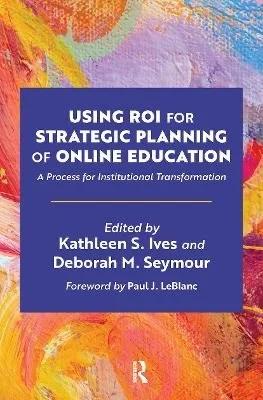
Contributed Chapter 2022 (Routledge): ROI and Shared Governance
Conferences, Workshops, and Presentations
Roderic Hewlett’s presentations and workshops bridge economics, leadership, institutional development, AI, stakeholder systems, Franciscan thought, treasury management, and capital theory. His work integrates academic scholarship with practical leadership, organizational strategy, and ethical economic development across academic, professional, and faith-based audiences.
Featured Workshops and Conferences:
2026 Secular Franciscan Summer Workshop
Building the Perfect Bonfire: Franciscan Choices in a Secular World
A three-session workshop for Secular Franciscans exploring vocation, discernment, stakeholder responsibility, servant leadership, and Gospel-centered decision-making in contemporary society. Based on The Bonfire of the Verities: Franciscan Perspectives on Decision-Making and Choice, the workshop integrates Franciscan spirituality, Catholic social teaching, practical discernment tools, and formation-centered leadership. Hosted through the Franciscan Institute Summer Workshop Series.
2026 International Association of Franciscan Studies Conference
Franciscan Servant Leadership and Stakeholder Theory: Integrating Care, ESG, and Organizational Purpose
Presented at the inaugural International Association of Franciscan Studies conference on Franciscan Leadership. The presentation explores the relationship between stakeholder theory, servant leadership, Franciscan spirituality, ESG frameworks, synodality, and organizational purpose within contemporary institutions and markets.
Selected Academic and Professional Presentations:
Economics, Capital Theory, and Institutional Development
Accounting for Intangible Capital
Institute of Management Accountants Annual Conference, Las Vegas, 2012Integrating ERP, Liquidity Planning, and Capital Budgeting in the Treasury
Association for Financial Professionals Annual Meeting, Boston, 2011Mapping Risk and Capital Structure (Peer Reviewed)
Association for Financial Professionals Annual Meeting, San Francisco, 2009Data Analytics for the Development of Optimal Capital Structure
Association for Financial Professionals Annual Meeting, Los Angeles, 2008Optimal Capital Structure and Techniques for Enhancing Marginal Cost of Capital and Weighted Average Cost of Capital
Association for Financial Professionals Annual Meeting, Las Vegas, 2006Beyond CAPM: Alternate Valuation Techniques
Association for Financial Professionals Annual Meeting, San Antonio, 2005Dynamic Macroeconomic Fluctuations and Strategic Planning: Implications for Working Capital Management
Association for Financial Professionals Annual Meeting, Philadelphia, 2000A Tale of Two Economies: The Old and the New
Association for Financial Professionals Annual Conference, Chicago, 2001
These presentations established an early research trajectory focused on capital structure, treasury management, institutional strategy, intangible capital, and economic transformation, which later evolved into the current work on intellectual capital, AI, stakeholder economics, and ethical capital.
Knowledge Leadership, Human Capital, and Education
A Knowledge-Based Approach to Education: Human Capital Resource
Association of School Business Officials International (ASBO), Charlotte, 2003To Thine Own Self Be True: Knowledge Management
Association of Collegiate Business Schools and Programs Annual Conference, Houston, 2002Integrating Critical Thinking and Elaboration in an E-Learning Environment
Informatics Academic Conference, Singapore, 2000A Cognitive Development Model for Teaching Personal Finance
Association for Financial Services Annual Meeting, Boston, 2008Practice Makes Perfect: Integrating Business Practice in Education
Academy of Business Education and Financial Education Association Joint Conference, Mystic, Connecticut, 2004
These presentations helped shape Hewlett’s continuing research on knowledge systems, human capital, institutional learning, leadership formation, and intellectual capital development.
Franciscan Economics, Stakeholder Systems, and Ethical Capital
The Virtuous Economy
Franciscan Institute Summer Conference Series, 2023United States Fiscal and Monetary Policies That Establish Institutional Justice
Franciscan Connections Summer Conference, Franciscan Institute at St. Bonaventure University and Tilburg University, 2022Franciscan Servant Leadership and Stakeholder Theory: Integrating Care, ESG, and Organizational Purpose
International Association of Franciscan Studies Conference on Franciscan Leadership, 2026
These presentations extend Hewlett’s work into Franciscan moral economy, stakeholder systems, institutional trust, ESG, ethical capital, and dignity-centered organizational leadership.
Economic Development and Community Leadership
Vision for a 21st Century North Dakota
Rural Economic Area Partnership (REAP), U.S. Department of Agriculture, 2003Developing Rural North Dakota
North Dakota Farm Bureau Winter Meeting, 2003The Sustainable Farm
North Dakota Farm Bureau Annual Meeting, 2004The University as a Catalyst for Economic Development
Central North American Trade Corridor Association, 2003The Economics of Tourism in Minot
Minot Convention and Visitors Bureau Annual Meeting, 2003Building Minot
Minot Association of Builders Annual Meeting, 2003Freedom and Capitalism: Which Came First?
Minot State University Humanities Lecture Series, 2004
These presentations reflect Hewlett’s long-standing interest in regional economic development, institutional resilience, rural sustainability, community formation, and stakeholder-centered development models.
Current Research and Future Writing Projects
Indigenous Moral Economy: Institutions, Ecological Stewardship, and Stakeholder Societies
A historical and institutional analysis of Indigenous societies viewed as stakeholder economies grounded in ecological stewardship, governance, reciprocity, and intergenerational responsibility. The study combines institutional economics, moral anthropology, environmental history, and capital theory to understand indigenous societies as resilient moral economies driven by dignity, stewardship, and communal accountability.
Franciscan Leadership in the 21st Century: Stewardship, Servant, and Stakeholders.
A leadership framework emphasizing institutional durability, stakeholder accountability, AI-era leadership, and long-term organizational stewardship. Built upon an eight-hundred year tradition.
Research Themes
Across these projects, several recurring themes emerge:
AI as intellectual capital and institutional infrastructure
Ethical capital and stakeholder coordination
Institutional trust and decentralized governance
Human flourishing and dignity-centered economics
Moral formation and long-term decision-making
Knowledge systems, capital formation, and organizational learning
Intergenerational responsibility and sustainability
Leadership, stewardship, and institutional resilience
Franciscan and Thomistic approaches to economics and social order
Community stability, local resilience, and mission-driven organizations
Selected Journal Articles and Professional Contributions
Hewlett’s earlier scholarship anticipated many of the themes developed in his recent books, particularly intellectual capital, institutional performance, capital structure, treasury management, and knowledge-based organizational systems.
Selected works include:
“Treasury Value Creation: Integrating Strategic Planning, Capital Budgeting, Enterprise Risk Management, and Liquidity” (Journal of Corporate Treasury Management, 2011)
“A Practitioner’s Guide to Estimating Weighted Average Cost of Capital and Determining Capital Structure” (Journal of Corporate Treasury Management, 2008)
“Accounting for Intangible Capital” (Institute of Management Accountants Workshop, 2012)
“A Knowledge-Based Approach to Education Human Capital Resource” (School Business Affairs, 2003)
“Integrating Human Capital Concepts in Productivity and Growth Topics” (Journal of Management Research, 2002)
“In Plain Sight: Crafting a 21st Century Future for Northern Plains Communities” (Economic Development Journal, 2004)
These earlier works established the foundation for Hewlett’s current research program on intellectual capital, stakeholder systems, institutional trust, AI-enabled coordination, and ethical economic development.
Professional Background
Roderic Hewlett is an economist, author, educator, and retired Lieutenant Colonel whose career spans higher education leadership, corporate finance, international business, treasury management, and military service.
His academic leadership roles include serving as Senior Vice President for Academics and Chief Academic Officer at Bellevue University (Nebraska), Executive Vice President and Chief Academic Officer at Walsh College (Michigan), Dean of the College of Business and Graduate School at Minot State University (North Dakota), and Vice President of Product Strategy and Development for Laureate Education, Inc. (Maryland). Throughout his executive leadership career, Rod continued to teach and develop courses in economics, finance, leadership, international business, strategy, and MBA education.
His faculty appointments include roles at Western Governors University, the University of Dubuque, Clarke University, Middle Tennessee State University (adjunct), Roane State Community College (adjunct), and Southwestern University of Finance and Economics in Chengdu, China (adjunct), where he taught executive MBA courses in knowledge and human capital management and treasury and capital market management.
Before academic leadership, Hewlett worked in corporate finance, pricing, treasury, and capital management roles with Northrop Corporation, Textron Corporation, Sundstrand Corporation, and Hadeed Saudi Iron and Steel Company (SABIC) in Saudi Arabia. He also served as Chief Financial Officer for International Schools Group in Dhahran, Saudi Arabia.
Hewlett served in the United States Army and Army National Guard from 1976 to 2002, retiring as a Lieutenant Colonel. His assignments included command and staff leadership roles in field artillery units and operational service with Special Operations Command Europe during deployments supporting operations in Bosnia, Europe, the Middle East, and Africa.
He holds a Doctor of Arts in Economics from Middle Tennessee State University with concentrations in economics, econometrics, corporate finance, and capital markets.